How to Get Barcodes for Food Products in Pakistan
How to Get Barcodes for Food Products in Pakistan
Are you selling packaged food products in Pakistan? Whether you manufacture spices, honey, sauces, snacks, biscuits, dry fruits, or other food items, barcodes can help you prepare your products for retail sales and manage your inventory more efficiently.
If you plan to supply grocery stores, supermarkets, distributors, or online shops, you may need product barcodes that meet the requirements of your intended sales channels.
In this guide, we'll explain how to get barcodes for food products, how to calculate the number you need, and how to prepare your packaging before ordering labels.
Why Do Food Businesses Need Product Barcodes?
As your food business grows, managing products manually can become difficult. Barcodes can help identify individual products and support inventory and checkout systems that use barcode scanning.
Here are some reasons food businesses use product barcodes:
Retail preparation: Help prepare packaged products for retailers that require scannable barcodes.
Inventory management: Distinguish between different products and packaging sizes.
Product identification: Make it easier to identify items during stock handling and checkout.
Business expansion: Prepare products for distribution through additional shops and sales channels.
Organized product records: Keep product identifiers consistent across packaging and inventory records.
A barcode does not replace food licensing, product registration, labelling, or food-safety requirements. Check the applicable rules for your product and location separately.
Which Food Products Can Use Barcodes?
Barcodes can be useful for many packaged food products, including:
Spices and seasoning powders
Honey and jams
Sauces, ketchup, and chutneys
Biscuits, cookies, and packaged snacks
Rice, flour, and pulses
Dry fruits and nuts
Tea and coffee
Cooking oils
Packaged sweets and confectionery
Ready-to-cook and other packaged food products
Whether you manufacture these products yourself or sell them under your own brand, planning your barcode requirements early can make packaging preparation easier.
Do Different Pack Sizes Need Different Barcodes?
In general, different product variations that are sold as distinct retail items need separate product identifiers.
For example, suppose your brand sells turmeric powder in 100 g and 200 g packs, and red chilli powder in the same two sizes.
| Product variation | Barcodes to plan for |
|---|---|
| Turmeric powder - 100 g | 1 |
| Turmeric powder - 200 g | 1 |
| Red chilli powder - 100 g | 1 |
| Red chilli powder - 200 g | 1 |
| Total | 4 |
In this example, you would plan for four distinct product barcodes.
The same principle may apply to different flavours, formulas, or packaging formats when they are treated as separate sellable products.
Important: You generally do not need a new barcode for every individual packet. Identical units of the same product variation can use the same product barcode.
Which Barcode Format Should You Choose for Food Products?
EAN-13 is widely used for retail products in Pakistan and many international markets. However, the right format depends on your retailer, inventory system, and intended sales channel.
Before choosing a barcode package, confirm:
Which barcode format your retailer accepts
Whether each product size or variation needs its own identifier
How many unique products you currently sell
Whether you plan to introduce additional pack sizes
Which barcode image formats are included with your package
If you intend to supply a particular supermarket, distributor, or online marketplace, check its requirements before ordering barcodes or printing packaging in bulk.
How Many Barcodes Should Your Food Business Buy?
The quantity depends on your current product range and planned expansion.
For example, if you sell five different products and each comes in three distinct pack sizes, you may need 15 product identifiers if every size is treated as a separate retail item.
Use this simple calculation to estimate your requirements:
Number of products × number of distinct variations = estimated barcode quantity
This is a planning guide rather than a universal rule. Your exact requirement depends on how your products are structured and the requirements of your sales channels.
Before purchasing a package:
Make a list of all your food products.
Record every pack size and distinct variation.
Count the unique sellable items.
Consider products you plan to launch soon.
Select a barcode package with a suitable quantity.
Planning ahead can help you avoid ordering too few barcodes as your business grows.
How to Buy Barcodes for Food Products in Pakistan
Once you've identified your product range and estimated the quantity you need, you can explore barcode packages online.
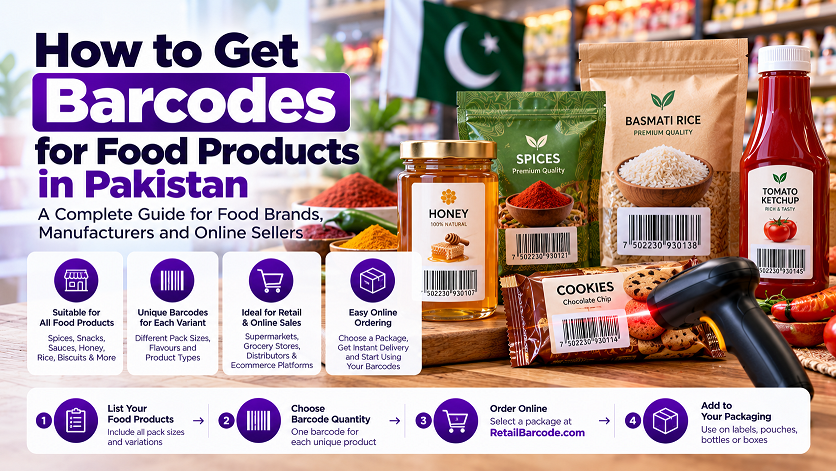
Step 1: Prepare your product list
List each product, such as spices, sauces, snacks, or honey, along with its pack sizes and variations.
Step 2: Calculate the required quantity
Count the distinct products and variations that need separate identifiers.
Step 3: Choose a barcode package
Visit RetailBarcode.com and review the available packages to find a quantity that fits your business.
Step 4: Place your order
Follow the website's ordering instructions and provide accurate information where requested.
Step 5: Prepare your packaging
Use the supplied barcode artwork on your product labels, pouches, jars, bottles, boxes, or other suitable packaging.
Step 6: Test the printed barcode
Print a sample and scan it with a compatible barcode scanner. Check that the barcode is readable before printing large quantities of packaging.
Step 7: Confirm retailer requirements
If you are supplying supermarkets, distributors, or online platforms, make sure the barcode type and identifier meet their requirements before your products go on sale.
Tips for Printing Barcodes on Food Packaging
Food packaging comes in many forms, from flexible pouches and plastic bottles to glass jars and cardboard boxes. A barcode should remain easy to scan after printing.
Follow these practical tips:
Print dark bars against a light background for good contrast.
Keep the barcode away from folds, seams, and curved edges where possible.
Avoid placing the barcode across transparent or highly reflective areas if they interfere with scanning.
Do not stretch or distort the barcode artwork.
Leave adequate clear space around the barcode.
Ensure the barcode is not obscured by stickers, seals, or decorative graphics.
Test a sample on the actual packaging material before mass printing.
If you use a packaging supplier, provide the barcode artwork early so the label layout can be checked before production.
Barcode Packages for Food Manufacturers and Private-Label Brands
Whether you operate a small spice business, produce packaged snacks, manufacture sauces, or are launching a private-label food brand, choosing the right barcode quantity can help you prepare your products for retail and inventory management.
At RetailBarcode.com, you can explore available barcode packages and select a quantity based on your product range.
Visit RetailBarcode.com to review the available packages for your business.
Before purchasing, confirm that the barcode identifiers and format are accepted by the retailers or platforms where you plan to sell.
Frequently Asked Questions
Do I need a barcode for every food product?
You generally need a separate product identifier for each distinct retail product variation that requires its own identifier. Different pack sizes or flavours may need separate barcodes.
Can 500 identical packets use the same barcode?
Generally, yes. Identical units of the same product variation can use the same product barcode.
Do different weights of the same food product need different barcodes?
If the different weights are sold as distinct retail items, they generally need separate product identifiers. Confirm the requirements of your retailer or sales channel.
Can I print a barcode on a food pouch or jar?
Yes. Barcodes can be printed on suitable labels or packaging, provided they remain readable and meet the requirements of your intended sales channel.
Does a barcode certify that a food product is safe?
No. A barcode identifies a product in systems that use it; it does not certify food safety, quality, ingredients, or regulatory compliance.
Where can I buy barcodes online in Pakistan?
You can explore available packages at RetailBarcode.com. Check the requirements of your intended retailer before ordering.
Get Your Food Products Ready for Retail
Planning to launch a new food brand or expand your existing product range? Start by listing your products, calculating the number of distinct variations, and checking your retailer's barcode requirements.
Then visit RetailBarcode.com to explore available barcode packages and choose an option that fits your business.
Verify a Barcode
Check global registry details and official ownership status instantly.
Need Barcode Numbers?
Get retail-ready EAN & UPC codes with instant delivery and lifetime ownership.
View Packages Buy Barcode in Multan
 Pakistan
 Buy Barcode in Larkana
 Buy Barcode in Gujrat
 Buy Barcode in Lahore
 Buy Barcode in Sukkur