How to Get a Barcode for Your Product: A Complete Step-by-Step Guide
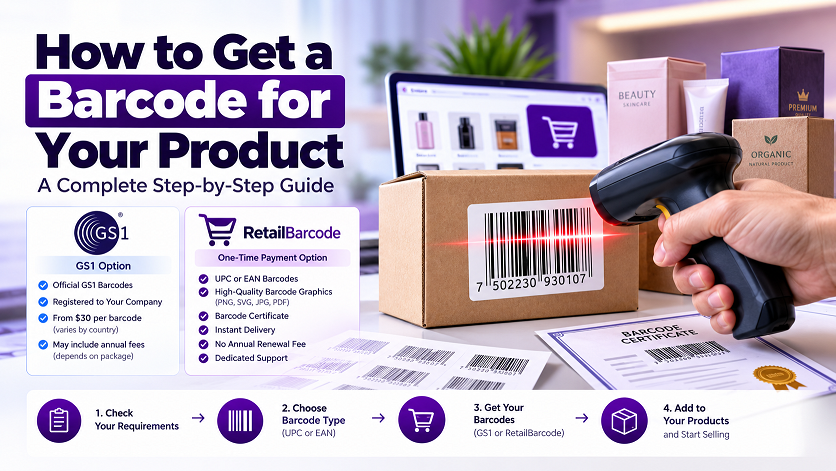
How to Get a Barcode for Your Product: A Complete Step-by-Step Guide
Planning to launch a new product, start an ecommerce business, or sell your products in retail stores? You may need a product barcode to help retailers and inventory systems identify your products.
But where should you get a barcode? Do you need to join GS1, and are there alternatives that offer a one-time payment without annual renewal fees?
The right choice depends on where you plan to sell, what your retailer requires, and how you want your product identifiers managed.
In this guide, we explain how to get a barcode for your product, compare the available options, and help you choose the solution that fits your business.
What Is a Product Barcode?
A product barcode is a machine-readable symbol printed on product packaging or labels. It represents a product identification number that compatible scanners and business systems can read.
Two common retail barcode formats are UPC-A and EAN-13.
Product barcodes are commonly used for:
Clothing and fashion accessories
Cosmetics and skincare products
Food and packaged goods
Electronics and accessories
Household products
Toys and consumer goods
A barcode image and a product identification number are not the same thing. The image is the scannable representation, while the number identifies the product according to the applicable identification system.
Step 1: Check Whether Your Retailer Requires GS1 Barcodes
Before buying a barcode, check the requirements of your intended retailer, distributor, or online marketplace.
Some sales channels require GTINs issued directly by GS1 and may verify the product identifier against the GS1 database. Other businesses may have different requirements depending on their sales channels and product categories.
Ask your retailer these questions:
Must the product identifier be issued directly by GS1?
Does the identifier need to be registered to my own company or brand?
Will the retailer accept barcodes obtained from an independent barcode seller?
Are there specific UPC or EAN format requirements?
This is the most important step because the cheapest option is not necessarily the right option for every business.
If your retailer requires a GS1-issued identifier, purchase it directly from GS1. If your sales channel accepts the type of barcode package we offer, RetailBarcode.com may be a suitable alternative.
Step 2: Understand Your Two Barcode Purchasing Options
Businesses can encounter different options when sourcing product barcodes. Here is how to decide which route is appropriate.
Option A: Purchase Barcodes Directly From GS1
GS1 is the organisation behind the global standards used for product identification, including Global Trade Item Numbers (GTINs).
If you need an identifier issued directly by GS1, you can obtain it through the appropriate GS1 member organisation.
GS1 pricing depends on the country and the type of licence or package you choose. Some options include recurring annual fees, while others do not.
For example, the following are published prices from official GS1 websites:
| Provider and option | Published price |
|---|---|
| GS1 US - individual GTIN | $30 per GTIN, with no annual renewal fee |
| GS1 US - 10-product company-prefix tier | $250 initially, plus $50 annual renewal |
| GS1 UK - entry-level membership | £50 per year for 10 GTINs, excluding VAT |
These prices are examples, not universal GS1 rates. Prices, eligibility, and licence terms may change.
You can check the official information here:
GS1 global barcode information: https://www.gs1.org/standards/get-barcodes
GS1 US pricing: https://www.gs1us.org/upcs-barcodes-prefixes
GS1 UK pricing: https://www.gs1uk.org/about-us/membership/get-a-barcode
When should you choose GS1?
Choose GS1 directly if your retailer or marketplace requires GS1-issued identifiers, if you need your products identified under your own company's GS1 allocation, or if you need the wider services included in a GS1 membership.
Option B: Buy a One-Time-Payment Barcode Package From RetailBarcode.com
If your intended retailer or sales channel does not require you to obtain identifiers directly from GS1, you may consider an alternative barcode package.
RetailBarcode.com offers barcode packages designed for businesses that need product barcode numbers and the associated graphics without an annual renewal fee charged by us for the purchased package.
Depending on the package, you can receive:
UPC or EAN barcode numbers
Barcode graphics in available formats, such as PNG, SVG, JPG, or PDF
A barcode certificate
Digital delivery
Customer support
Our one-time-payment approach helps customers plan their barcode purchasing costs without an ongoing annual membership fee payable to RetailBarcode.com.
Before ordering, confirm that the number source, assignment terms, documentation, and barcode type are suitable for your intended use. Our packages are not a substitute for GS1-issued identifiers when a retailer or marketplace specifically requires them.
Who may benefit from this option?
Independent sellers, small businesses, and ecommerce merchants who have confirmed that their sales channel accepts the type of barcode package offered may find this a convenient option.
Ready to explore your options?
Visit RetailBarcode.com to browse our available barcode packages and choose a quantity that fits your product range.
Step 3: Choose the Right Barcode Format
Once you understand your sales channel's requirements, determine which barcode format you need.
UPC-A Barcodes
UPC-A barcodes contain 12 digits and are widely used for retail products in the United States and Canada.
They are commonly seen on packaged consumer goods, clothing, electronics, and household products.
EAN-13 Barcodes
EAN-13 barcodes contain 13 digits and are widely used for retail products in many countries around the world.
They are common on consumer goods sold through shops, supermarkets, and ecommerce businesses.
The appropriate format depends on the requirements of your intended sales channel. A barcode's visual format alone does not prove that its underlying number is correctly assigned or accepted by a particular retailer.
Step 4: Decide How Many Barcodes You Need
The quantity you need depends on the number of distinct products and variations you sell.
For example, suppose you sell a T-shirt in three sizes and two colours. If every size and colour combination is treated as a distinct retail trade item, you would generally need six different product identifiers.
Other examples include:
Different clothing sizes
Different cosmetic formulations
Different package quantities
Different product flavours
Different product models
Identical units of the same identified product generally use the same barcode. You do not need a new identifier for every physical unit sold.
Prepare a list of your products and variations before purchasing. This helps you estimate the required quantity and choose an appropriate package.
Step 5: Prepare Your Product Information
Depending on your barcode provider and sales channel, you may need information such as:
Company or brand name
Product name and description
Product size, colour, or model
Packaging quantity
Contact details
Keep this information accurate and consistent across your website, product labels, inventory system, and marketplace listings.
If you sell multiple products, a spreadsheet can help you manage product descriptions and barcode assignments.
Remember that a barcode certificate supplied by a seller is not automatically equivalent to an official GS1 registration or proof of acceptance by a retailer.
Step 6: Receive and Download Your Barcode Graphics
After obtaining an appropriate product identifier, you can use a corresponding barcode graphic on your product packaging.
Depending on the package you select, files may be available in formats such as:
PNG for common digital uses
JPG for supported image workflows
SVG for scalable vector artwork
PDF for suitable printing workflows
Check the files supplied with your chosen package and use a format compatible with your packaging or label design process.
Always ensure that the digits shown beneath the barcode match the intended product identifier.
Step 7: Add the Barcode to Your Product Packaging
Place your barcode in an appropriate area of the product packaging or label.
For reliable scanning:
Use strong contrast between the barcode and its background.
Preserve the required blank space around the barcode.
Avoid stretching or distorting the graphic.
Use suitable dimensions and print quality.
Avoid folds, seams, or reflective surfaces that interfere with scanning.
Follow the specifications applicable to your barcode type and your retailer's packaging requirements.
Step 8: Test Your Barcode Before Selling
Before printing a large batch of labels, test a sample.
Check that the barcode scans correctly with a compatible scanner. If your products will be listed on a marketplace or supplied to a retailer, verify that the identifier and product information meet that organisation's requirements.
A successful scan only confirms that the barcode can be read. It does not necessarily confirm that the number is registered to your company or accepted by a particular marketplace.
Testing your labels early can help prevent avoidable printing costs and listing delays.
Frequently Asked Questions
Can I buy barcodes without an annual renewal fee?
Yes. Some barcode providers offer packages with a one-time payment and no annual renewal fee charged by that provider. RetailBarcode.com offers this purchasing model for its barcode packages.
However, check the package terms and make sure the identifiers meet your retailer's requirements before purchasing.
Do all GS1 barcodes require annual renewal?
No. Renewal requirements depend on the GS1 organisation and the product or licence option. For example, GS1 US offers individual GTINs for a one-time fee with no annual renewal, while company-prefix packages have annual renewal fees.
Always check the specific option available in your country.
Can I use RetailBarcode.com barcodes on Amazon?
Amazon's product identifier requirements depend on its current policies, the marketplace, and the product. Some listings may require identifiers issued directly by GS1, while certain products may qualify for exemptions.
Before purchasing, check Amazon's current requirements for your specific product and marketplace. Do not assume that every independently sourced barcode will be accepted.
Do I need a barcode for my own online store?
Not necessarily. If you sell exclusively through your own website, you may be able to manage your products without retail barcodes. Barcodes become more relevant when you need scanning, inventory integration, distribution, or compliance with retailer requirements.
Can I use one barcode for different products?
Generally, distinct products or variations that require separate trade item identification need different identifiers. Identical units of the same identified product can share the same barcode.
What is the difference between a barcode number and a barcode certificate?
The barcode number is the product identifier represented by the barcode graphic. A certificate is a document supplied by a provider to record information about a purchase or assignment.
A certificate from an independent seller does not, by itself, establish GS1 registration or guarantee marketplace acceptance.
Choose the Right Barcode Option for Your Business
Getting a barcode should be straightforward, but choosing the right source is essential.
If your retailer requires GS1-issued identifiers, purchase them through the appropriate GS1 organisation. If your sales channel accepts the type of barcode package we offer, a one-time-purchase option may be a practical way to obtain the graphics and documentation you need without an annual renewal fee charged by RetailBarcode.com.
We believe customers should understand what they are purchasing before placing an order.
Explore Barcode Packages at RetailBarcode.com
Visit https://retailbarcode.com/ to review our available packages and find an option suited to your products, budget, and confirmed sales-channel requirements.
Please verify retailer and marketplace policies before purchasing. Barcode acceptance depends on the applicable requirements and the source and assignment of the product identifier.
Verify a Barcode
Check global registry details and official ownership status instantly.
Need Barcode Numbers?
Get retail-ready EAN & UPC codes with instant delivery and lifetime ownership.
View Packages Buy Barcode in Larkana
 Buy Barcode in Hyderabad
 Buy Barcode in Gujranwala
 Buy Barcode in Bahawalpur
 Buy Barcode in Islamabad
 Buy Barcode in Quetta